
A Foreigner/Tourist Guide to Fine Dining & Omakase in Japan
Japan’s home to some of the best cuisine, and the country seemingly host endless amounts of restaurants, and it can feel overwhelming on how to choose where to eat when there are way too many options.
Navigating through the fields of Japan’s fine dining scene isn’t the most straightforward, especially as a foreigner. Factors like language barrier, lack of access to Japanese phone numbers, and restaurants’ preferences to regular customers are the top reasons why it’s difficult in getting started in general.
Thankfully, many restaurants have opened up more opportunities for foreigners to book through specialized online platform services, and this guide will show you how to research for restaurants in Japan and how to use the booking platforms. No phone calls or Japanese language ability needed.
Sites to know for finding Japan’s restaurants
There are really few reliable resources you can use to find restaurants in Japan. Tabelog and your navigation app.
Tabelog
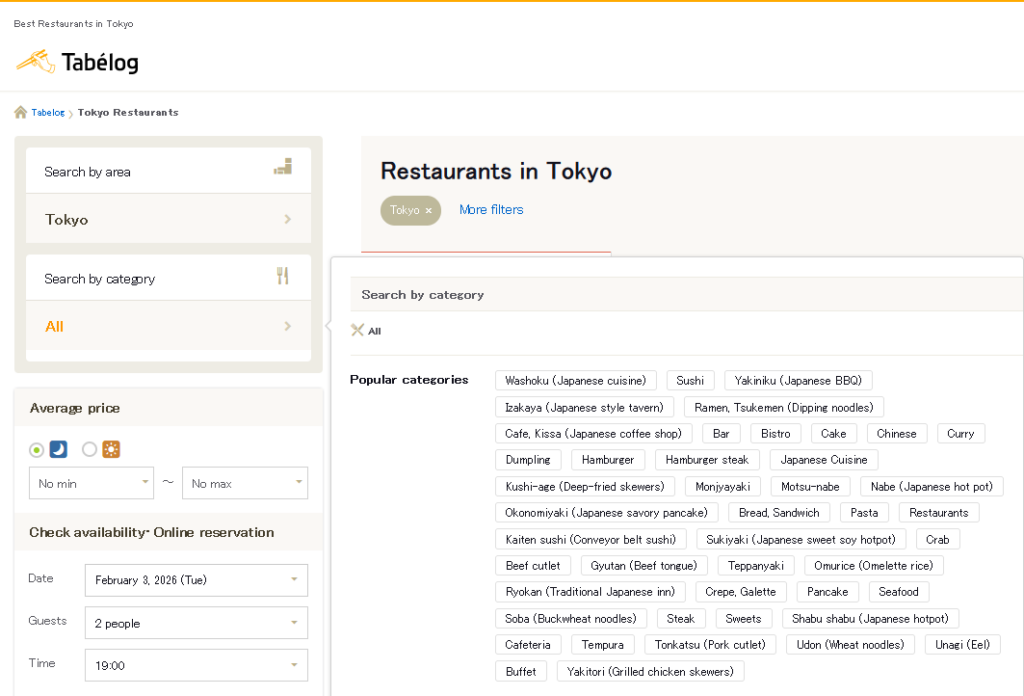
Tabelog is a top source for everything food-related in Japan. It’s basically the Japanese Yelp. It’s a very comprehensive platform where you can browse different food categories within locations down to the nearest subway station. It’s an excellent resource for casual and fine dining.
For the best experience, I recommend using the desktop version of the site rather than the mobile version.
One crucial thing you’d need to be aware of as a foreigner is that the Japanese review culture differs slightly than western countries. Japanese reviewers tend to be way more reserved in giving out 5-stars so then the average ratings of the restaurants will be lower than what a foreigner’s typically exposed to.
Tabelog uses a weighted-scale 5-star rating where the default starts at 3-star, and will move up and down depending on the number of reviews, credibility of the reviewers, and the scores given.
The majority of restaurants in Japan will float around 3 stars which imply that they are “good as expected”, and is considered as a positive. Here’s the rule-of-thumbs of the score ranges in Tabelog:
- <3.0: Mediocre to bad
- 3.0-3.4: Good as expected
- 3.4-3.7: Very good
- 3.7-4.0: Excellent
- 4.0+: Top 0.1% of the restaurants in the country
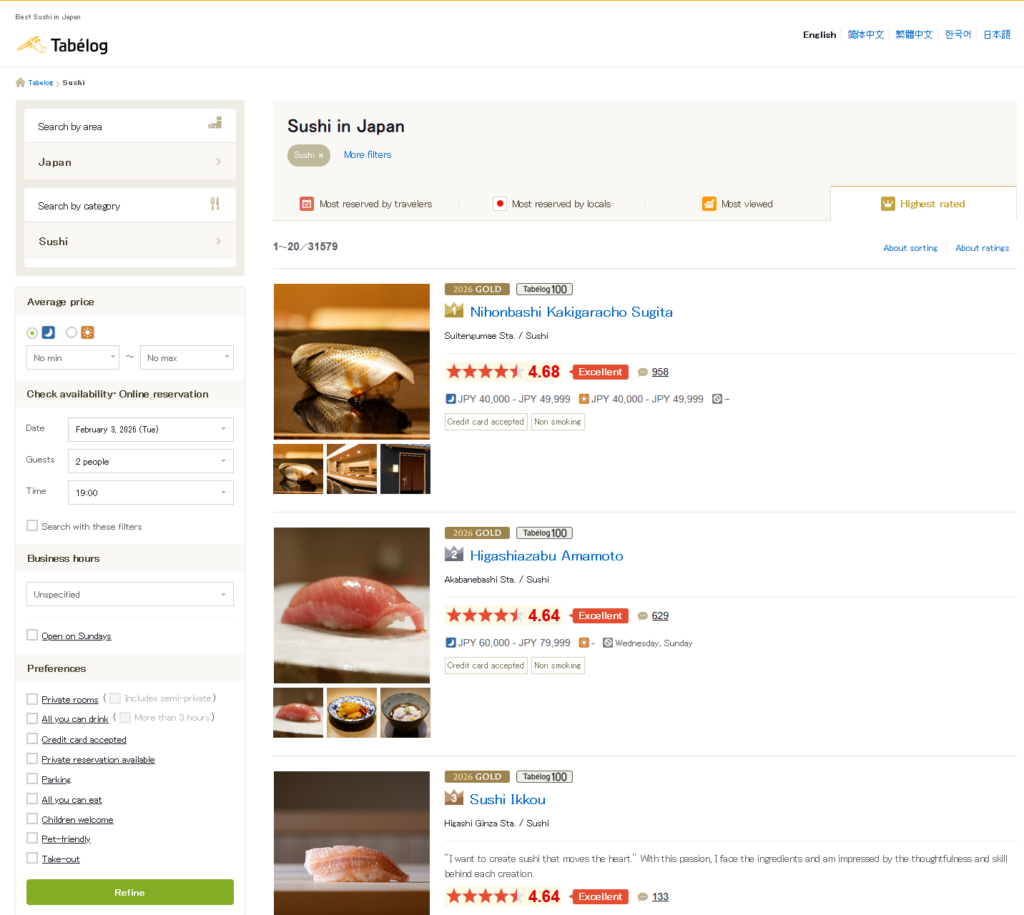
Tabelog also award accolades yearly to qualified restaurants in different categories:
- Tabelog 100 (Hyakumeiten): These are awarded to the top 100 rated restaurants per food category and per region.
- Tabelog Bronze: Awarded yearly to ~400-500 restaurants in all of Japan
- Tabelog Silver: Awarded yearly to ~100 restaurants in all of Japan
- Tabelog Gold: Awarded yearly to ~30 restaurants in all of Japan
Now, you might think you’d want to book as many as Tabelog Silver-Gold as much as you can on your next vacation to Japan. But you’d be disappointed if you blindly follow the ratings. Restaurants with Tabelog awards, especially Gold, are some of the most competitive restaurants to book and is realistically not accessible to most foreigners unless they get really lucky.
Plus, I don’t believe it’s necessary to enjoy Japanese fine dining with only the top-end of the spectrum, and you’ll most likely still have a great time with restaurants at 3.7 range up to Tabelog Bronzes that tend to be more accessible for foreigners. I also had my fair shares of better experiences in lower-rated restaurants.
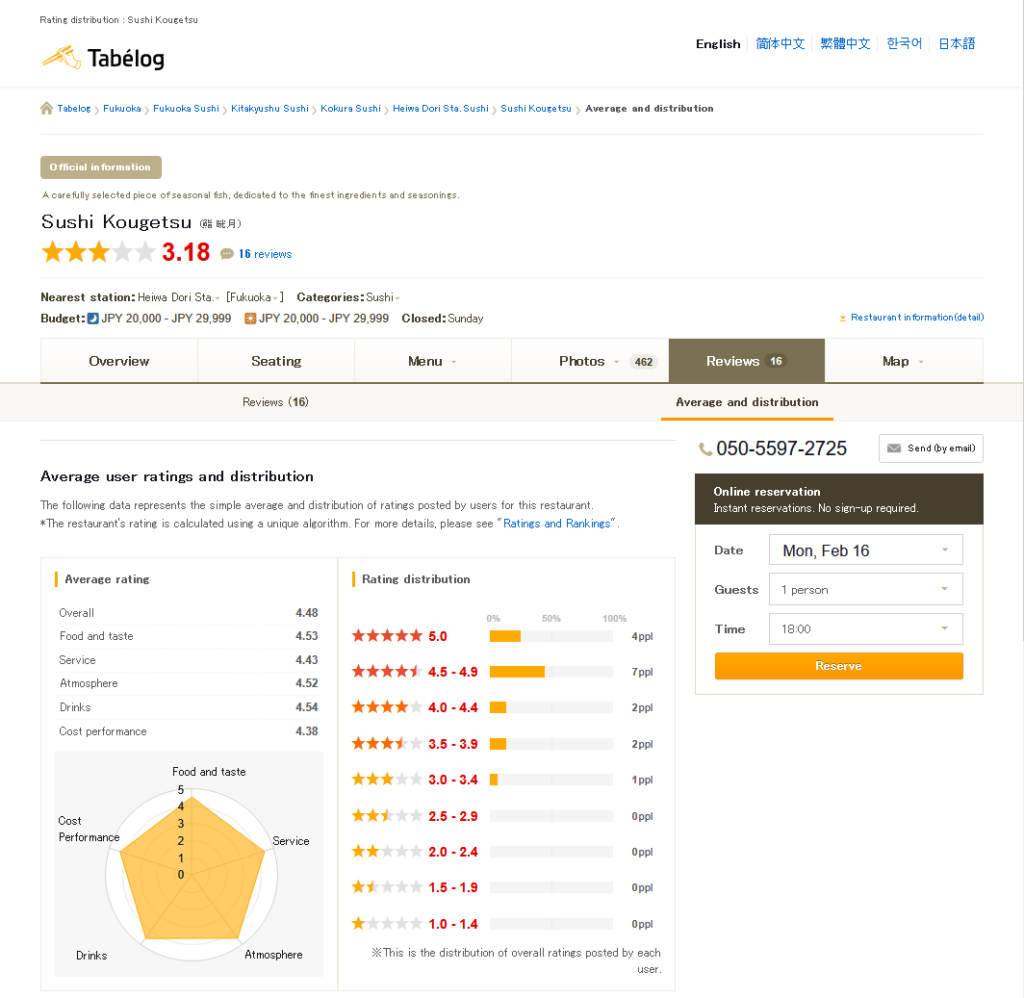
Tabelog’s ratings is not perfect. Because the number of reviews influence the ratings, new restaurants will experience some growing pains in their ratings even if they’re well-reviewed, placing them at low 3 star range at the beginning. It’s also difficult to know what new restaurants are worth checking out unless you’re well-attuned to the industry which is not a big deal to most of us. Thus, you should look at the “Average and Distribution” under the Reviews tab to get a clearer picture and they can represent different scoring from the main star ratings.
I also find it to be more biased in favor of the already more established restaurants.
It has flaws to the system, but it’s still the best publicly-available resources out there for anything food in Japan. Lastly, food is very subjective at the end of the day. Tabelog caters to the Japanese local taste, and that itself can already be much different than a foreigner’s. The best way to find out whether you’ll like the food or not is to try them out for yourself.
Google Maps
Google Maps or your preferred navigation app is still a very handy resource in differentiating between how a foreigner reviews an establishment vs. how a Japanese would. The main way to differentiate them is in the language. If a place has majority of their reviews done in English, then that would most likely mean that it was done by a foreigner. High star ratings are also to be scrutinized because a foreigner and a local Japanese may find a restaurant to be equally good, but the foreigner would rate it as 5-star when the Japanese would put a 3-star.
Japanese Fine Dining Online Platforms
Below are the five online platforms I use to book potential restaurants. Simply create accounts for them to start using them. These can also be used to research for restaurant names where you can cross-reference restaurants found on these platforms with Tabelog and vice versa.
Some overlap with the same restaurant may occur but it’s still worth checking them all if that’s the case since the availability may differ, and your booking will be valid once secured. Incidental holds are needed for most, so I recommend using credit cards to reserve.
Omakase.in
Omakase is one of the main platforms with good variety of food categories across the country, and is possibly the one I use the most.
Details like the course price and reservation schedules will be apparent here.
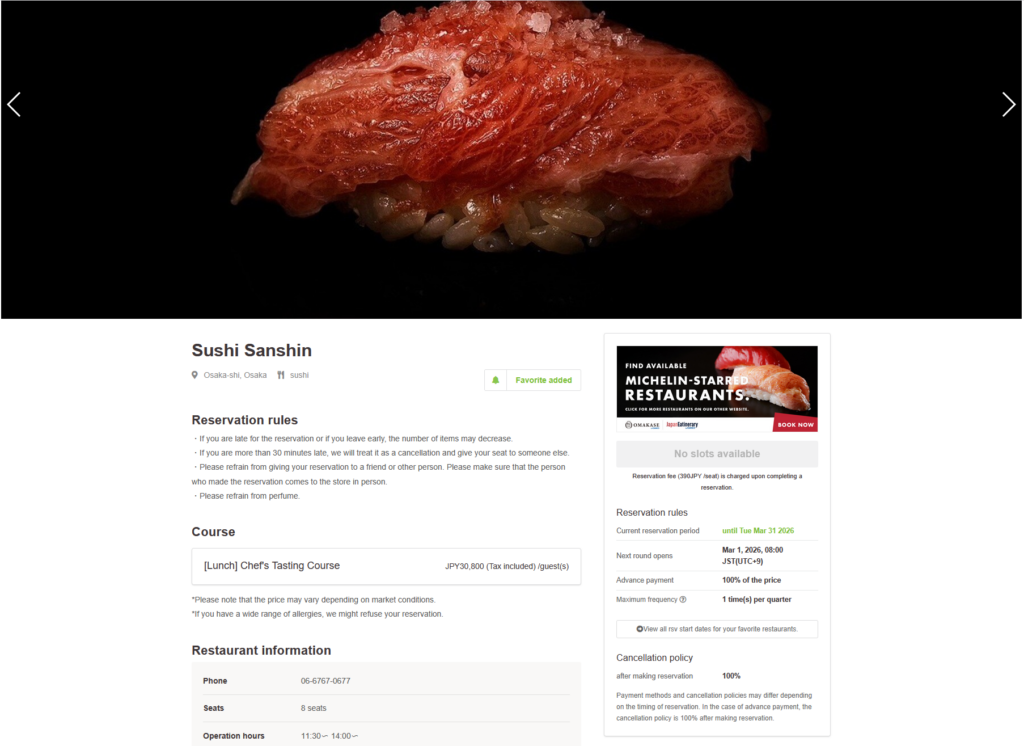
There is a non-refundable 390 yen booking service fee in Omakase, and cancellation policy for the restaurant will be transparently displayed. They will also display when the next schedule of openings so you can prepare ahead of time better.
Examples of restaurants I’ve booked through Omakase:
- Sushi Namba Hibiya
- Niku to ieba Matsuda Nara Honten
- Tonkatsu Narikura
- Tempura Sakurabito
- Yakitori Ichimatsu
- Torisho Ishii Hina
TableCheck
TableCheck is another option worth looking at. Compared to Omakase, TableCheck has many more options ranging from casual food like ramen and tokatsu to fine dining like sushi and kaiseki. Hotel restaurants are commonly found here as well.
There’s typically no booking fee when booking a reservation through TableCheck, but cancellation fees still apply (read the restaurant’s cancellation policy as each will be different).
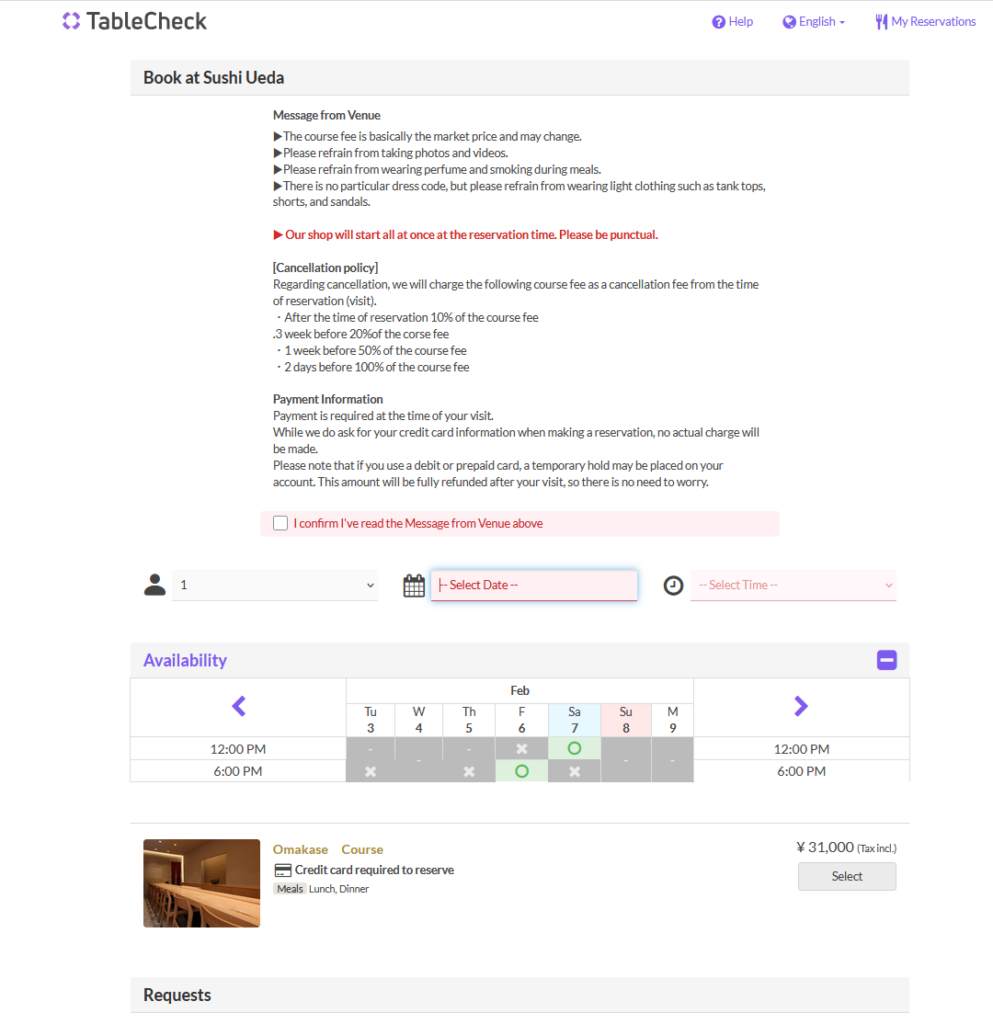
Examples of restaurants I’ve booked through TableCheck:
- Sushi Sakai (Fukuoka)
- Kyomachibori Nakamura
- Shio Soba Jiku
- Nikuryori Chii-chan
- Sushi Ueda (Kobe)
Pocket Concierge
Pocket Concierge can be another option. However, the selections aren’t as wide as Omakase or TableCheck. Still, there are few standout examples like Kiyama for kaiseki in Kyoto (~4.4 stars, Tabelog Silver) and Sushi Jubei in Fukui (~4.5 stars, Tabelog Silver).
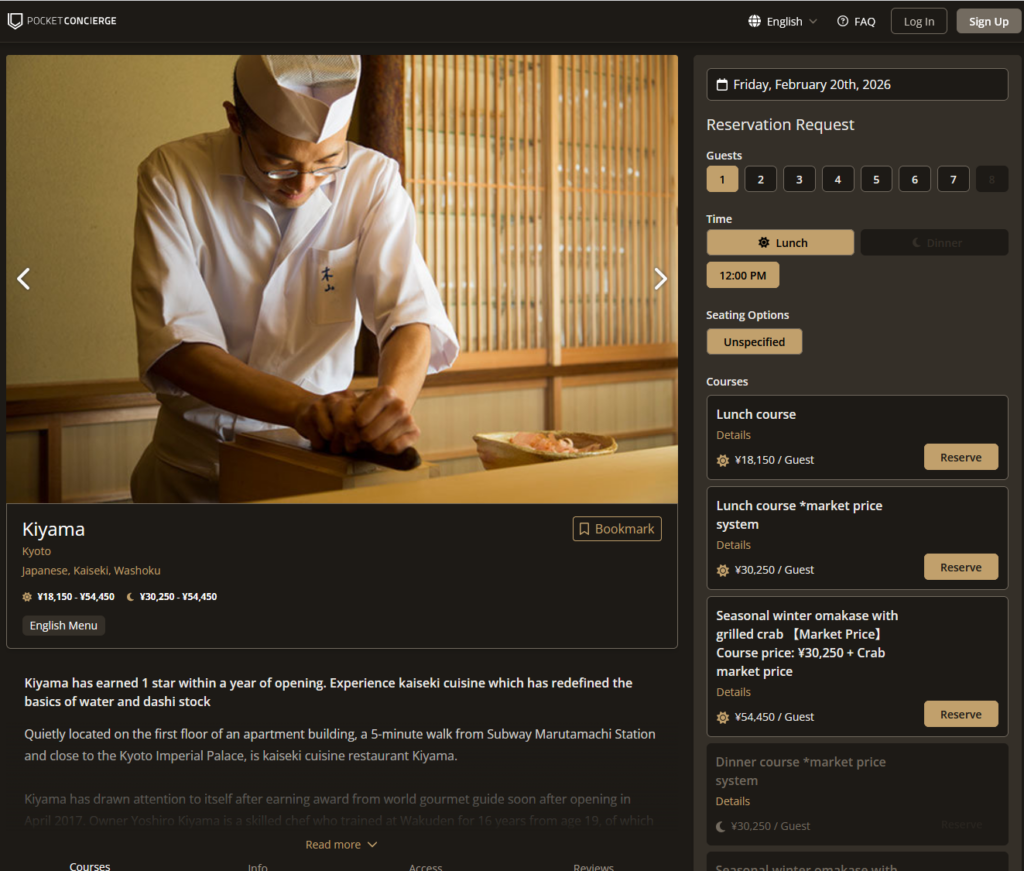
There’s typically no booking fee by booking through Pocket Concierge, but cancellation policies still apply per restaurant.
Tabelog
Tabelog offers reservation system for certain restaurants, and sometimes it may be the only option to go for. If a calendar appears under the restaurant, that means that a reservation is bookable through Tabelog. It does come with a non-refundable 440 yen booking fee unless if the restaurant themselves cancel your booking.
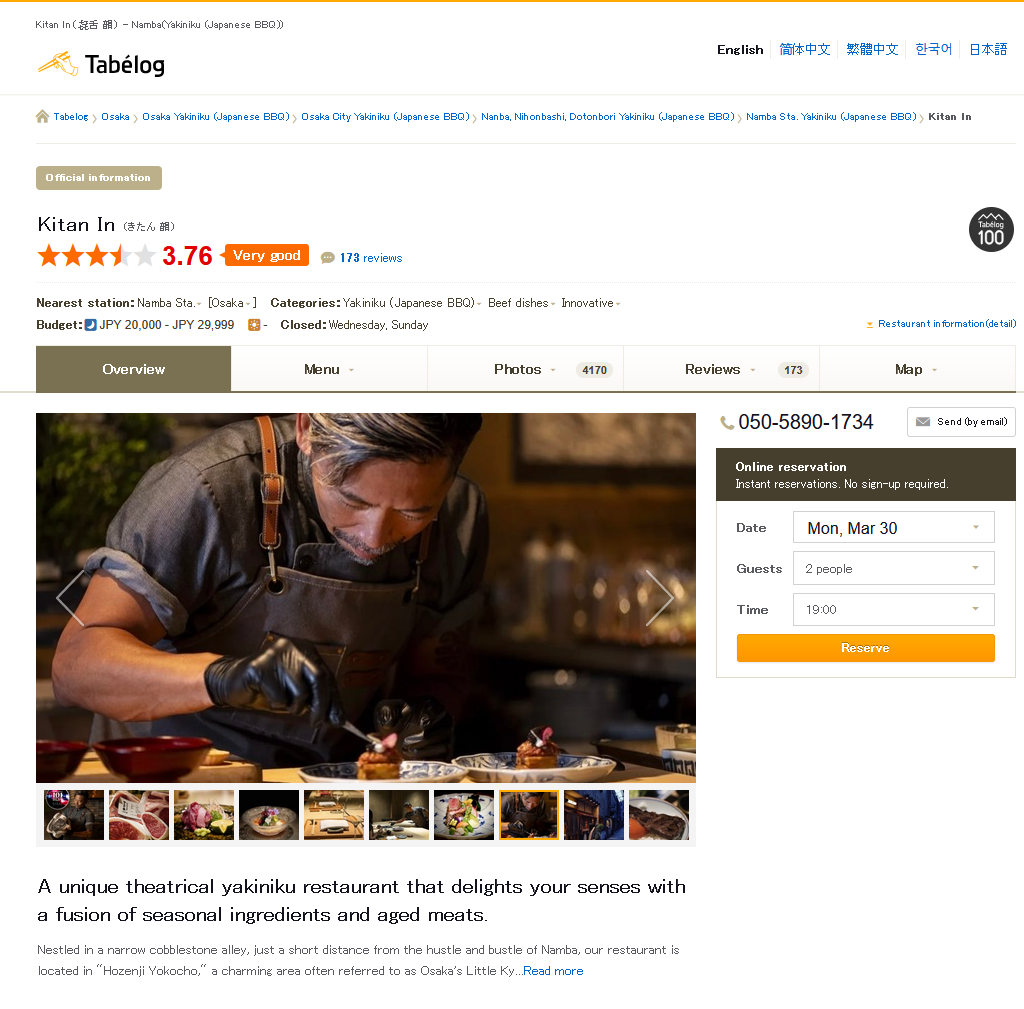
Tableall
Tableall is the last booking platform I’ll mention here. It’s unfortunately my least favorite as it has a non-refundable 8000 yen booking fee plus higher base charges. Double foreigner tax so to speak.
But, it can be your only option as a foreigner as it may have availability that you can’t find anywhere else. I’d only do it if it’s a restaurant you really want to try and would go out of your own way to be there.When you set up email alerts on your desired dates, a concierge will email you once they find an availability to confirm if you like to proceed with the booking. The booking fee won’t be charged after making an alert.
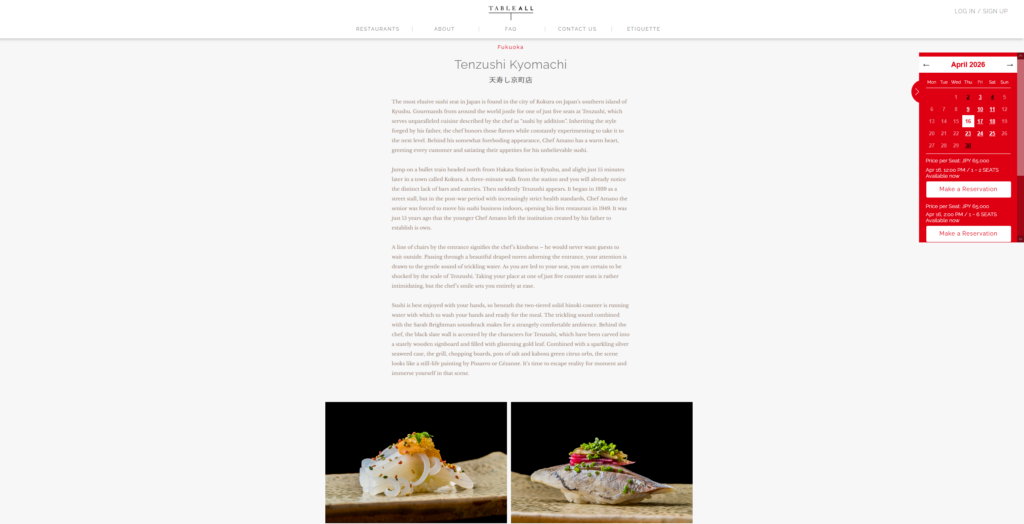
I personally booked Tenzushi Kyomachi through Tableall before knowing that it could be done through Ritz-Carlton Fukuoka‘s concierge.
Hotel Concierge
5-star hotel concierge could be an option to help you get some reservations. But, it’s very inconsistent and varies a lot depending on the hotel so it’s hard to be conclusive in regard to their reliability.
Different hotels will have different relationship with the nearby restaurants, and some restaurants would not share their availability with hotel concierges or even let them book on the customer’s behalf.
Not to mention that they’d only start helping you once you’re close to your stay date which adds a layer of difficulty in getting a reservation.
Personally, I find them not very reliable, and they tend to only help you with restaurants you could’ve booked yourself after you familiarize yourself with the known online platforms. I would suggest keeping them in mind as a backup option rather than as your main method in securing reservations.
How soon should you start making reservations?
Availability schedules will vary a lot by restaurants. In general, you should prepare around 1-3 months in advance by knowing what places you want to go to. Online platforms’ calendar for each restaurants could also give you general sense on when you can start your booking process. Some, like Omakase, will notify you when the schedule opens.
Cancellations can be pretty frequent and is worth keeping an eye on as they can create opportunities for last-minute bookings.
Keep in mind that the upper echelon of restaurants are very competitive where there are many who will set up scripts or bots to secure reservation as soon as the new schedule opens. Availability could be gone within seconds!
It’s important to note couple of restaurants you’re interested in and have backup options if you can’t secure your primary ones.
Japanese Fine Dining Etiquette
Here are the key etiquette to know:
- Don’t wear perfume
- Don’t be late
- Note any dislikes/allergies ahead of time (can be done through the online booking platforms)
- Respect the photography rules. Most are OK with taking photos, but some won’t allow you to take any pictures.
Dress codes are typically pretty lax, and I’ve seen my fair shares of customers wearing simple short-sleeve shirts and jeans up to ones with 3-piece suits. Though wearing tank tops, shorts, and flip-flops are no-nos.
Conclusion
Booking restaurants in Japan is made simpler for foreigners with online platforms like Omakase, TableCheck, Tabelog, Pocket Concierge, and Tableall. Cross-reference the restaurant names found on these platforms on Tabelog so you can get better insights with reviews made by Japanese locals.
Getting a reservation can be very competitive, so it’s a good idea to have multiple options in mind in case you can’t get some of them, and monitor for last-minute cancellations which is surprisingly more common than it should.
